
Stay Visible In A World of AI Summaries
Roslyn Rice • June 30, 2025
This is a subtitle for your new post

As artificial intelligence or AI-powered summaries increasingly dominate search results, especially on platforms like Google, the traditional SEO (Search Engine Optimization) playbook is evolving. A recent Gallup
article states how AI use at work has doubled in 2 years. Now, businesses must think beyond keywords and backlinks and focus on feeding AI platforms accurate, structured and consistent data that they can draw from confidently.
GEO
(Generative Engine Optimization) is the practice of optimizing your business content to be readable, retrievable and relevant
for generative AI tools. Unlike traditional SEO, which focuses on ranking in blue links, GEO is about being referenced
in AI answers and summaries.
5 Practical Tips for Generative Engine Optimization (GEO)
1. Structure Your Website for AI Crawlers
- Identify your business name, services, location, hours, and FAQ in multiple AI platforms (ex: Chat Gpt or Claude).
- Make sure key information is on your homepage and about/contact pages—AI scrapers prioritize accessible summaries.
2. Publish Clear, Factual Content Frequently
- Create blog posts, service pages, and FAQs that answer “who, what, where, why, how” questions about your business.
- Focus on plain English, not marketing fluff. AI favors fact-rich language and easy-to-reference statements.
3. Appear on High-Authority Sites
- Get listed (accurately) on places AI trusts: Google Business Profile, Yelp, Better Business Bureau, local chambers, trade associations, news features.
- Write guest blogs or be quoted in articles. AI often sources answers from reputable editorial content.
4. Maintain Brand Consistency Across Platforms
- Keep your business name, tagline, services, and contact details identical across your website, social media, and directories.
- Inconsistencies confuse AI and reduce your authority as a source.
5. Monitor and Influence AI Mentions
- Search your business name on Perplexity, ChatGPT, Microsoft Co-Pilot and Google Gemini to see what shows up.
- If outdated or incorrect information appears, update it on the original source or use Google Search Console and webmaster tools to make corrections.
If you need support on organically optimizing your reference on various AI tools, schedule time with a consultant from DPI LLC.

Strategic Networking in the Fall: How September Conversations Can Build Your 2027 Business Pipeline The room is filled with business owners exchanging handshakes, business cards, and quick introductions. One person moves rapidly from conversation to conversation, sharing the same sales pitch with everyone they meet. Another person slows down, asks thoughtful questions, and listens carefully. A week later, the first person has a stack of business cards but no meaningful conversations to continue. The second person has three scheduled follow-up meetings and a better understanding of what potential clients and referral partners need. The difference is not how many people they met. It is how strategically they connected. Why Is Fall an Important Time for Business Networking? After a slower summer season, September is when consumers, business owners, and organizational decision-makers begin to reengage. Teams return to regular schedules, leaders review their goals, and companies start planning for the holiday season and the coming year. That makes fall one of the most valuable times for small and midsize businesses to increase visibility, reinforce their authority, and develop new relationships. The conversations you begin in September may become contracts, referrals, partnerships, or new customers in 2027. However, those results rarely come from attending one event and immediately making a sale. Effective business networking is a relationship-building process that requires preparation, genuine curiosity, and c onsistent follow-up . Networking Is More Than Showing Up Strategic networking means being intentional about where you go, who you want to meet, and what you want people to remember about your business. Before attending a networking event, ask yourself: Who is likely to attend? Are these potential clients, referral partners, or industry connections? What business challenges are they likely experiencing? How can my experience or network help them? What is the next step I want to create after the conversation? You do not need to enter every room focused on closing a sale. A more productive goal may be to identify three people with whom you want to continue the conversation. Quality connections are more valuable than a large collection of business cards. Stop Making the Conversation About Your Business One of the most common networking mistakes is spending too much time explaining your company, products, qualifications, or services. Yes, people need to understand what you do. But they are more likely to remember how you made them feel and whether you showed a genuine interest in their needs. Instead of leading with a lengthy sales pitch, enter the conversation in listening mode . Try asking: What are you focused on growing right now? What has been your biggest business challenge this year? What are you preparing for during the final quarter? What is working well in your business? What type of connection or resource would be helpful to you? These questions create room for the other person to share what matters to them. They also help you uncover pain points, priorities, and opportunities without forcing a sales conversation. Strategic networking begins with curiosity, not a pitch. How Should You Introduce Your Business? Your introduction should be clear, conversational, and focused on the value you provide. Instead of listing every service you offer, briefly explain: Who you help What challenge you help solve What result you help create For example: “I help established small businesses strengthen their operations and leadership practices so they can grow without everything depending on the owner.” This type of introduction gives the other person enough information to understand your value while leaving room for a natural conversation. The goal is not to explain your entire business in 30 seconds. The goal is to create enough interest for the conversation to continue. Professional Does Not Mean Unapproachable Business owners need to get out of the office and become visible in the places where relationships are being built. That may include industry conferences, chamber events, community meetings, association gatherings, workshops, or small invitation-only events. When you attend, show up professionally but also be relatable. People want to connect with business owners who are knowledgeable and credible, but they also want to talk with someone who is approachable and authentic. Avoid treating every interaction like a formal presentation. Share useful insights, ask good questions, and participate in the conversation as a person not simply as a company representative. People do business with people they know, trust, and believe understand their needs. The Follow-Up Is Where Networking Produces Results Meeting someone is only the beginning. Without follow-up, even a strong conversation can quickly be forgotten. Within 24 to 48 hours, send a short, personalized message that references something specific from your discussion. Avoid sending the same generic message to everyone. Your follow-up might say: “It was good meeting you at yesterday’s event. I enjoyed hearing about your plans to expand your team next year. Your comments about improving the onboarding process stayed with me. I would be glad to continue the conversation over coffee or a brief Zoom call.” A thoughtful follow-up demonstrates that you listened. It also gives the relationship a clear next step. Consider using a simple networking follow-up system: Record the person’s name, company, and contact information. Note what you discussed and any pain points they mentioned. Send a personalized follow-up within 48 hours. Share a relevant resource or make a helpful introduction. Schedule the next conversation when there is mutual interest. Add an appropriate reminder to reconnect later. Networking success is not measured by attendance. It is measured by the relationships you continue to develop. Connect Your Networking to Your Fall Visibility Strategy In-person networking should support the other ways your company communicates with its audience. When someone meets you at an event, they may visit your website, search for your business online, or review your social media pages before responding. This is why your fall marketing strategy should also include: Consistent social media posts Email announcements about company updates Client success stories Educational articles and videos Upcoming events or speaking engagements Clear descriptions of your services and expertise Strong branding in September helps establish the visibility and trust your business needs going into the holiday season and the new year. Your networking, email marketing, online presence, and brand message should tell the same story about the value your business provides. Turn Fall Conversations Into Future Business September is not simply the beginning of fall. It is an opportunity to become more visible, strengthen your authority, and start conversations that can shape your 2027 business pipeline. Be selective about the events you attend. Enter each conversation ready to listen. Follow up with intention. Continue providing value long before you ask for the sale. The objective is not to leave an event with the most contacts. The objective is to build the right relationships and create meaningful reasons to stay connected. DPI LLC helps established small and midsize businesses develop practical growth strategies, improve operations, strengthen leadership, and prepare for their next stage of business. If you are ready to become more strategic about how your company attracts opportunities and converts relationships into revenue, connect with us on Instagram at @doubleportion or Facebook at @DPI2LLC .

It's Just Not Intentional. The biggest AI risk in your business isn't the technology. It's the lack of a plan. If you walked through your office today and asked every employee whether they use AI, you might be surprised by the answer. One person uses ChatGPT to draft emails. Another uses Microsoft Copilot to summarize meetings. Someone in marketing uses AI to write social media posts, while your operations manager relies on it to organize spreadsheets. Your salesperson may even be using AI to prepare for client meetings. At first glance, this sounds like progress. But here's the question most business owners never ask: Who decided how AI should be used? If the answer is "everyone figured it out on their own," then your business already has an AI strategy, it just wasn't intentionally designed. For many small and mid-sized businesses, AI adoption has happened organically. Employees are experimenting with different tools, creating their own prompts, and developing individual workflows. While that initiative is encouraging, it also creates inconsistency, unnecessary risk, and missed opportunities. The businesses that will benefit most from AI over the next five years won't necessarily have the newest technology. They'll have the clearest standards. AI Is Already in Your Business Whether You Planned for It or Not Many leaders believe they're "thinking about AI." In reality, AI has likely been part of daily operations for months. Employees are using it to: Draft emails Create presentations Summarize meeting notes Write job descriptions Analyze spreadsheets Brainstorm marketing ideas Build training documents Research competitors None of these activities are inherently problematic. The problem is that every employee is making independent decisions about how AI should be used, what information can be entered, and how much they should trust the results. Without clear expectations, every person creates their own version of your company's AI strategy. The Hidden Risks Most Business Owners Don't See AI can significantly improve productivity, but it also introduces risks that many organizations overlook. 1. Confidential Information Employees may unknowingly enter customer information, financial data, pricing strategies, employee records, or proprietary business information into public AI tools. Without clear guidance, sensitive information could be exposed beyond your organization. 2. Inconsistent Customer Communication If five employees use AI differently, customers receive five different writing styles, messaging approaches, and levels of quality. Your brand becomes inconsistent. 3. Inaccurate Information AI is an excellent assistant but it is not always correct. Without human review, incorrect policies, inaccurate calculations, or misleading information can quickly make their way into client communications. 4. Lost Knowledge When employees create effective prompts but never document them, the business loses valuable intellectual property. Every employee starts from scratch instead of building on what already works. 5. No Accountability When AI generates content, who is responsible for reviewing it? Without defined ownership , mistakes become everyone's problem and no one's responsibility. AI Needs Standards Just Like Every Other Business Process Most businesses have standards for: Hiring Payroll Customer service Financial reporting Information security AI should be treated no differently. The goal isn't to control every prompt your employees write. The goal is to create a consistent framework that allows your team to use AI confidently, responsibly, and securely. AI Readiness Checklist Before expanding your use of AI, every business should have these foundational elements in place. □ AI Usage Policy Define which AI tools employees are approved to use and which activities require management approval. □ Data Security Standards Clearly identify what information may never be entered into AI platforms, including: Customer information Financial records Employee data Confidential contracts Proprietary business processes Passwords or system credentials When in doubt, assume confidential information should remain outside public AI tools unless your organization has approved enterprise solutions and security controls. □ Human Review Process Every AI-generated document should be reviewed by a person before it is shared externally. AI should accelerate work not replace professional judgment. □ Brand Voice Guidelines Provide examples of your company's preferred tone, messaging, and communication standards so AI-generated content remains consistent across your organization. □ Approved Prompt Library Instead of every employee reinventing the wheel, build a shared library of prompts for recurring business tasks such as: Proposal writing Customer emails Meeting summaries Job descriptions Performance reviews Marketing content Standard operating procedures Over time, this becomes a valuable internal knowledge base. □ AI Training Expectations Don't assume employees know how to use AI effectively. Provide practical training that covers: Prompt writing Fact-checking Security practices Ethical use Quality control Appropriate business applications □ AI Workflow Documentation Document where AI fits into existing business processes. For example: Lead Inquiry → AI drafts response → Employee reviews → Manager approves (if needed) → Customer receives communication Clear workflows reduce confusion and improve consistency. □ Success Metrics If AI is saving time, improving quality, or increasing productivity, measure it. Track metrics such as: Hours saved each month Faster proposal turnaround Reduced administrative work Improved response times Increased employee productivity Higher customer satisfaction If you're not measuring outcomes, it's difficult to determine whether AI is creating real business value. AI Is a Business Strategy—Not Just a Technology Tool Many organizations approach AI as another software subscription. The most successful businesses view it differently. AI should support your business strategy, strengthen your operations, improve decision-making, and help your people perform at a higher level. When implemented intentionally, AI becomes part of your operating system—not just another app your employees use. The question isn't whether your team is using AI. The question is whether they're using it consistently, securely, and in a way that supports your business goals. Is Your Business AI Ready? If your employees are already experimenting with AI, now is the time to establish the standards that protect your business while maximizing the value AI can deliver. At DPI LLC , we help business owners evaluate their current AI usage, identify opportunities for improvement, reduce security risks, and develop practical AI standards that fit the way their business operates. Our AI Readiness Assessment provides a clear roadmap so your team can adopt AI with confidence rather than guesswork. Visit DPI2.com to schedule your AI Readiness Assessment and begin building an intentional AI strategy that supports your growth.

July is the perfect time to pause and ask one simple question: What is my business trying to tell me? Many business owners have valuable data sitting inside QuickBooks, Jobber, Shopify, Square, their CRM, or point-of-sale system. The problem isn't a lack of information, it's that no one is looking at it. Software costs money. They provide invaluable insights into your business. Don't overlook those reporting features. The businesses that finish the year strong aren't always the ones that started strong. They're the ones that review their numbers, make adjustments , and stay focused. The good news? There is still plenty of time to make 2026 your best year. Your Data Is More Than Numbers Your reports tell a story . They can show you: Which products or services are actually making money Where sales are slowing down Which customers buy repeatedly Whether your marketing is producing results Where time or money is being wasted The goal isn't to collect more reports. The goal is to use them to make better decisions. Start Creating Your Baseline If you are not tracking your business consistently, start with a few simple metrics. Review each month: Total sales Number of new customers Repeat customers Top-selling products or services Gross profit Average sale or invoice amount Quotes sent versus deals closed Outstanding invoices waiting to be collected You don't need a complicated dashboard. You just need consistency. Our DPI team meet weekly about our metrics. They help us shift strategy and uncover gaps in our sales process. Your Mid-Year Business Reset Checklist Set aside one hour this month and ask: Am I on track to reach my 2026 goals? What generated the most revenue so far this year? What isn't producing results? Which customer type is the most profitable? What expenses have increased? What conversations today could become sales in the next 60-90 days? What one change would have the biggest impact before year-end? Write down your answers and choose three priorities to focus on through December. Finish Strong Every successful business owner makes adjustments. Markets change. Customers change. Priorities change. The businesses that grow aren't guessing, they're measuring. Your historical data is one of the most valuable business advisors you already have. Start reading the story it is telling, make informed decisions, and use the second half of the year to build momentum. There is still plenty of time to change the outcome of 2026 . Our DPI LLC team is able to assist you with your Mid Year Review. Visit our website DPI2.com to schedule a complimentary session.
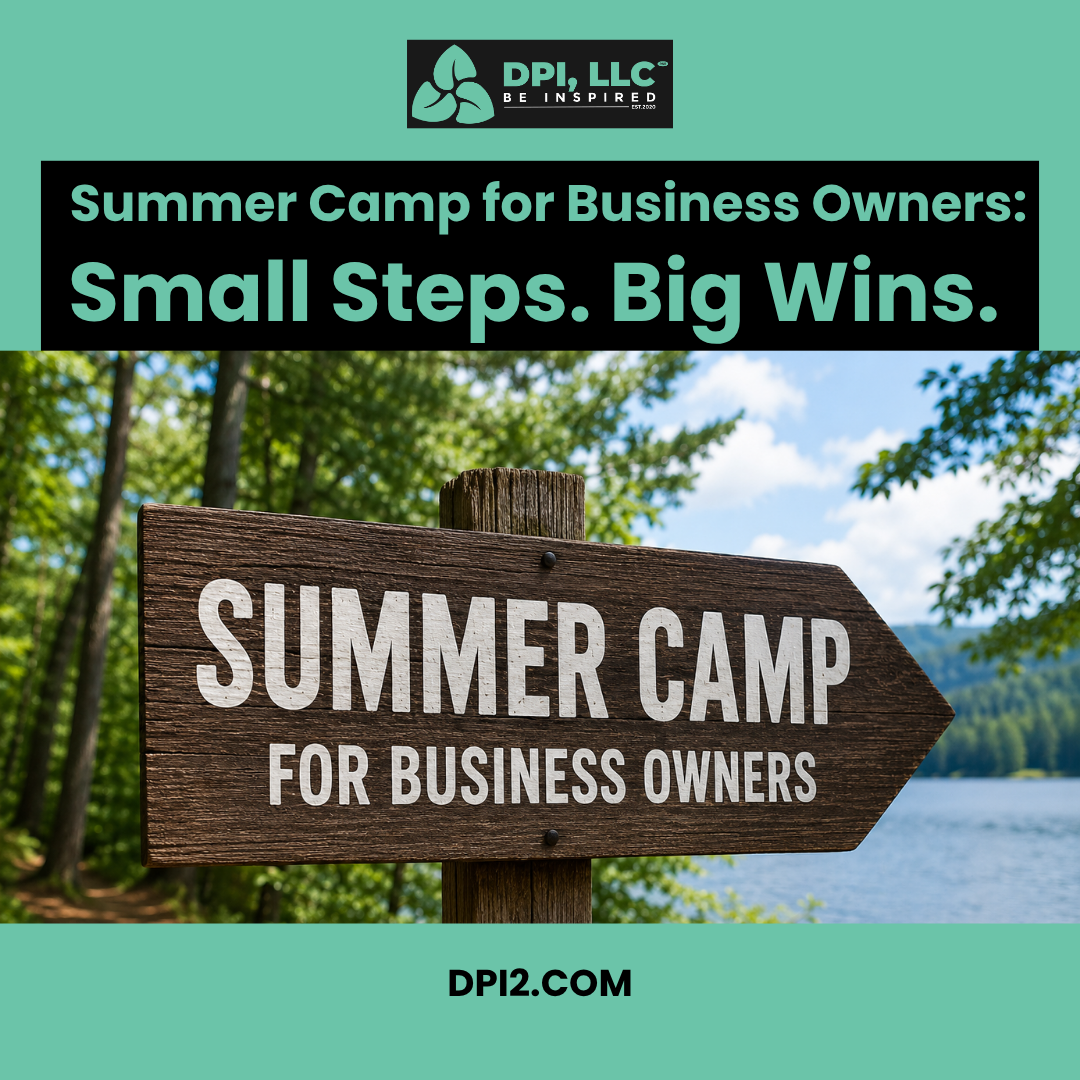
Summer can feel like recess for business owners. Clients travel, schedules shift, and teams slow down while juggling vacations and family time. But businesses that stay visible and consistent during slower seasons are often the ones that gain momentum in Q3 and Q4. This year, many companies are also navigating higher operating costs. Gas prices continue to impact shipping, vendor pricing, service calls, and raw materials. Waiting until fall to tighten operations could leave unnecessary profit on the table. Think of June as “Business Summer Camp”: a time to sharpen skills, clean up operations, and strengthen customer relationships before the busy season returns. Here’s the good news: growth does not always come from massive changes. Small, consistent actions compound over time. Summer Camp Checklist for Business Owners Customer Engagement Reach out to past clients with a quick check-in email or text Stay active on social media at least 2–3 times weekly Share behind-the-scenes updates, team moments, or customer success stories Review your sales funnel and follow up on old leads Expense Audit Review recurring subscriptions and unused software Compare vendor and supplier pricing Audit fuel, delivery, and travel-related expenses Identify products or services with shrinking profit margins Review overtime, scheduling efficiency, and unnecessary spending leaks Leadership Focus Hold shorter but consistent team check-ins Cross-train employees during slower weeks Refresh SOPs and operational processes Set one measurable revenue or efficiency goal for July Summer does not have to mean slowing down completely. Businesses that remain visible, disciplined, and connected during quieter months are often the businesses that enter the next quarter with stronger pipelines, healthier margins, and clearer direction. Our DPI LLC team is here to support your Business Summer Camp. Visit our website DPI2.com to learn more about our services.

When a disaster hits, most business owners think about physical damage first. Items such as inventory, equipment, and their workspace. What often gets overlooked are the documents that keep the business legally compliant, financially stable, and operational. Without access to contracts, financial records, employee information, and insurance policies, even a minor disruption can quickly turn into a prolonged shutdown. Cyber attacks are the new norm in our world. The reality is simple: your ability to recover isn’t just based on what you can rebuild, but on what you can access . Taking the time to properly back up and store your most critical documents (both digitally and in hard copy) can be the difference between a temporary setback and a complete operational standstill. Below are a list of the most critical documents to consistently back up: Business & Legal Business licenses and registrations Contracts (clients, vendors, leases) Insurance policies (property, liability, workers comp) EIN verification from the IRS Incorporation Documents Financial Bank account records Tax returns (last 3–5 years) Payroll records Accounts receivable/payable reports Operational SOPs (Standard Operating Procedures) and Workflow Documentation Employee Records and Contact Info Vendor and Supplier lists Employee Handbook Technology Password Manager Backup or Access Instructions Software Licenses IT Infrastructure Documentation Storage Best Practices Cloud Storage (secure, encrypted) External Hard Drive (offsite location)* Printed Copies In Waterproof/Fireproof Container *An external hard drive is a portable storage device connected to a computer via USB, Thunderbolt, or Wi-Fi to provide extra storage space. It is used for backing up data, storing large files, and transferring data between computers, acting independently of the computer's internal storage. The team at DPI LLC is here to support you in building your 'In Case Of Emergency" plan and business continuity plan. Visit our website DPI2.com to schedule a complimentary assessment.

Stop Funding Activity. Start Funding Outcomes. Too many business owners approve expenses with good intentions and vague expectations. They join networking groups, subscribe to software, hire vendors—and then simply “hope it works.” Hope is not a strategy. Clear goals are. If you don’t define what an expense is supposed to accomplish, you’ll never know whether it’s performing or quietly draining cash and time. Every Expense Needs One Clear Purpose Before spending a dollar, answer this: What is the primary outcome this expense must produce? Not five outcomes. One. A networking membership might exist to generate one new client per quarter. A CRM subscription might exist to increase close rate by 10%. A bookkeeper might exist to reduce errors and protect profit. If the goal isn’t specific, ROI will always feel unclear. Track the Real Investment (Not Just the Invoice) Most owners underestimate cost because they only look at the cash. Real Cost = Cash Cost + Time Cost That $65 networking membership may actually cost $365 when you include event time, follow-ups, and travel. That $120 software may require setup hours and ongoing management time. Time is money—especially when you’re the decision-maker. Measure Outputs That Matter Once the purpose is defined, track measurable outputs: For networking: Qualified leads Discovery calls Proposals sent Deals closed For software: Hours saved Faster turnaround Reduced errors Improved close rate If nothing measurable is improving, that expense isn’t performing. Convert Results Into Dollars You cannot calculate ROI without assigning value. Revenue ROI = Closed deals × profit per deal Time ROI = Hours saved × your hourly value Then apply the formula: ROI = (Return − Cost) ÷ Cost If you spent $1,095 over 90 days and only generated $1,000 in profit, that’s negative ROI. That doesn’t mean panic—it means decide. The Decision Rule: Keep, Fix, or Cut Every 90 days, review each major expense: Did it at least break even? Is there pipeline proof (leads, calls, proposals)? Is time investment shrinking or growing? Is there a clear next action? If there’s no clear next action, that’s a red flag. Strategic Owners Don’t “Show Up and Hope” They define success before spending. They measure consistently. They make data-based decisions quarterly. Expenses should either: Generate revenue Improve efficiency Reduce risk Enable growth If they do none of those, they are distractions disguised as investments. Clarity turns spending into strategy. And strategy protects profit. The DPI LLC team is able to provide an expense audit to ensure you expenses are generating revenue. Visit our website at DPI2.com .

Does tax season make your head hurt. Most business owners don’t struggle because they lack revenue; they struggle because they lack organized financial data. Scrambling for receipts in March is not a tax problem. It’s a bookkeeping problem that’s been building all year. Strong financial records are not a luxury, they are a strategic investment that protects your business and makes tax time manageable instead of overwhelming. Too many owners wait until tax season to realize their books are a mess, then scramble, stress, and often pay more than they should. Investing in a bookkeeper creates a foundation of clarity, control, and confidence that actually saves money and time. Here’s why hiring a bookkeeper is smart business: Top 5 Reasons to Hire a Bookkeeper 1. You stay organized year-round, not just at tax time A bookkeeper keeps your financial records accurate and up-to-date, so when taxes, audits, or strategic decisions come up, you aren’t scrambling to reconstruct your numbers. 2. You reduce costly mistakes and missed deductions Errors in your books lead to penalties, overlooked deductions, and inaccurate results. A professional catches issues early and keeps your financial data compliant and trustworthy. 3. You make better business decisions When your data is accurate and timely, your decisions about pricing, spending, hiring, and growth are informed — not guesswork. Clean books turn numbers into actionable insight. 4. You free up your time to lead and grow Time spent wrestling with receipts and reconciling accounts is time taken away from strategy, sales, and serving customers. Bookkeepers bring consistency and reliability so you can focus where you add the most value. 5. You’re ready for the future — funding, growth, or sale Lenders, investors, or buyers want clean books. Having reliable records signals discipline and stability, putting you in a stronger position for loans, partnerships, or an eventual exit. What It Costs In South Florida and across the U.S., small business bookkeeping costs vary based on transaction volume and service levels. Most small businesses pay somewhere between roughly $250 to $1,500 per month for ongoing bookkeeping services that keep books accurate and ready for taxes and reporting. Higher complexity or more frequent reporting may push toward the upper end of that range. Think of this as a predictable investment that prevents stress and financial surprises. A bookkeeper doesn’t just record numbers — they protect your profitability, give you clarity, and ensure you aren’t leaving money on the table. Hiring a bookkeeper means you’re choosing control over chaos, predictability over panic, and strong financial foundations over uncertainty. If you are not sure who to trust just ask our team. Feel free to email us at info@dpi2.com for more information.

There is something powerful about building a business. It starts as an idea, grows through long days and hard seasons and becomes something that supports families, employees, and entire communities. When done with intention, a business is more than income. It creates opportunity. It builds confidence. It changes lives. That kind of impact comes from love — love for the work, the mission, the people you serve. That love is what keeps owners going when things feel uncertain. It fuels innovation, service, and resilience. It is the reason many businesses become engines of stability and wealth that can last for generations. Love is a strength in business. But love without leadership can create blind spots. When Love Clouds Judgment Business owners often care deeply about what they’ve built. That emotional connection is real. The challenge is that passion can sometimes make it harder to make the decisions the business actually needs. Here are common pitfalls owners fall into: 1. Avoiding Hard Conversations Keeping an underperforming employee too long. Not addressing a partner issue. Delaying a pricing increase because it feels uncomfortable. Love for the team or fear of conflict can slow necessary action. 2. Underpricing Out of Loyalty Wanting to “take care of clients” by keeping prices low, even when costs rise. Over time, this erodes profit and creates stress that affects service quality and long-term stability. 3. Holding On to Old Systems Continuing with outdated processes or software because “this is how we’ve always done it.” Love for familiarity can block growth and efficiency. Fear of change wants to keep us comfortable. Growth happens in the uncomfortable. 4. Saying Yes to Everything Taking every opportunity, client, or project because you believe in the business so much. Everyone is not your customer. Without boundaries, this leads to burnout and diluted focus. 5. Delaying Strategic Planning Staying in daily operations because it feels productive, while avoiding the deeper work of planning for growth, succession, or long-term sustainability. Love for the business should not mean protecting it from change. Real leadership means guiding it toward what is necessary for it to thrive. Businesses That Change Lives Are Led Intentionally A sustainable business does three things well: It serves customers with excellence It supports the people who work in it It creates financial strength and stability That doesn’t happen by accident. It requires structure, strategy, and accountability. This is where giving yourself permission to have trusted partners matters. You don’t have to carry every decision alone. Consultants, and peer networks provide perspective that owners cannot always see from inside the business. They help you ask better questions, look at the numbers honestly, and map out what is next. Seeking support is not a sign of weakness. It is a sign that you take your responsibility as a leader seriously. Keeping Love and Leadership in Balance Here are practical ways to lead with both heart and clarity: 1. Separate Feelings from Facts Review numbers regularly. Revenue, profit, expenses, and performance metrics tell a story. Let data inform decisions, not just emotions. 2. Schedule Time to Work on the Business Block time monthly or quarterly for strategy, not just operations. Growth requires intentional thinking. 3. Create Clear Standards Define expectations for pricing, performance, customer experience, and processes. Standards reduce decision fatigue and emotional reactions. 4. Use Outside Perspective Have regular check-ins with a trusted advisor (such as DPI LLC) or mastermind group. They can challenge assumptions and help you see blind spots. 5. Revisit Your “Why” — and Your “How” Loving your mission is important. Equally important is ensuring the business model, systems, and team structure can support that mission long term. The goal is not just to run a business you love. The goal is to build a business that can stand strong , grow responsibly, and continue creating impact long after the early hustle fades. That is love in action. Visit our website DPI2.com to learn more about our trusted team.

If your business is making sales but your bank account doesn’t reflect it, you’re not alone. Many business owners work hard, sell consistently, and still wonder where the money goes. The truth is this: profit and cash flow aren’t driven by sales alone — they’re driven by what happens after the sale. Let’s break this down. Profit Isn’t Just About Earning More Profit is shaped by small, everyday decisions that quietly add up. Subscriptions you signed up for “just to try.” Software you don’t fully use. Tools that once helped but no longer serve your business. Meals or networking events that aren't turning into paid clients or customers. Each one may seem small, but together they quietly drain cash every month. These are profit stealers, expenses that don’t give you a real return. A quick reality check: If a subscription doesn’t save you time, reduce errors, or help you make more money, it’s not neutral. It’s costing you profit. Inventory Ties Up Your Cash If you sell products, inventory plays a major role in cash flow. The longer inventory sits on a shelf, the longer your money is locked up. This is why cash flow can feel tight even when sales are up. You already paid for it, but you haven’t received cash back yet. This is known as days inventory outstanding , how long it takes for inventory to turn into cash. Slow-moving inventory doesn’t just take up space. It limits your ability to: Pay bills comfortably Reinvest in marketing, advertising or growth Respond to opportunities quickly Inventory should move with intention, not hope. Sales Don’t Count Until Cash Is Collected For service-based and product-based businesses alike, cash flow depends on collection. Work delivered but not yet paid for creates a dangerous illusion of success. Invoices sitting unpaid are another form of money stuck in limbo. If you’ve already done the work, the faster you collect, the healthier your cash flow becomes. Small Tweaks Create Big Shifts You don’t need a finance degree to improve profit. You need visibility. Trim subscriptions that don’t earn their keep Track how long inventory sits before selling Tighten up billing and collection timelines These small adjustments often unlock more cash than chasing new sales ever will. Profit clarity creates confidence. And confidence lets you run your business with intention — not stress. The team at DPI LLC is here to help you improve your profit and get cash flowing through your business again. Visit our website DPI2.com to schedule a consulting session.

As 2025 winds down, business owners and HR leaders face a narrow window to tie up critical compliance and payroll processes before January arrives. A structured year-end review not only protects the organization but also strengthens readiness for the year ahead. At DPI, we believe in giving business owners clear, actionable steps that can be implemented quickly. This year’s HR priorities offer a meaningful opportunity to streamline operations. Below are the five most important HR tasks every organization should complete before the end of the year, based on the enclosed checklist resource. These actions support compliance, reduce risk, and ensure your team enters the new year with clarity and confidence. You can also provided a HR Checklist to ensure you stay on track. 1. Conduct a Comprehensive Compliance Review Before closing 2025, verify that all federal, state, and local labor requirements are up to date. This includes reviewing policies, updating required labor law postings, completing necessary employee notices, and confirming all workplace trainings have been completed. Compliance gaps discovered late often become costly mistakes—this review is a proactive safeguard. 2. Audit Personnel Files and Recordkeeping Take time to ensure personnel files are complete, accurate, and properly stored. Transfer terminated employee files to secure storage and confirm record retention requirements have been met. Clean files support clean audits. 3. Finalize Payroll, Taxes, and Year-End Reporting Audit payroll balances, confirm employee data, and prepare year-end forms such as W-2s and 1099s. Review carryover balances for PTO, schedule bonuses, and verify all tax information is correct before submissions begin in January. Even for employees that have separated from the company, you want to make sure you have an accurate mailing address to provide them with documents for their tax return filing. 4. Review Employee Benefits and Compliance Deadlines Assess benefits offerings, confirm ACA reporting requirements, verify eligibility lists, and distribute required notices. This is also the ideal time to evaluate whether your benefits remain competitive. 5. Complete Annual Performance Reviews and Update Job Descriptions Formal reviews reinforce expectations and help shape professional development for the year ahead. This is also the right time to update job descriptions to reflect actual responsibilities and evolving business needs. The DPI team has tools to support this year end task. An organized year-end HR process strengthens operational efficiency and reduces risk. If you’d like help implementing these steps, our team at DPI is ready to assist. The HR Checklist is our gift to you this holiday.




